Downsizing or Upsizing? How to Know When It's Time to Move in Snoqualmie
The Snoqualmie Valley's low transaction volume and the specific lifestyle character that draws buyers to the valley create a downsizing and upsizing dynamic that is genuinely diffe...

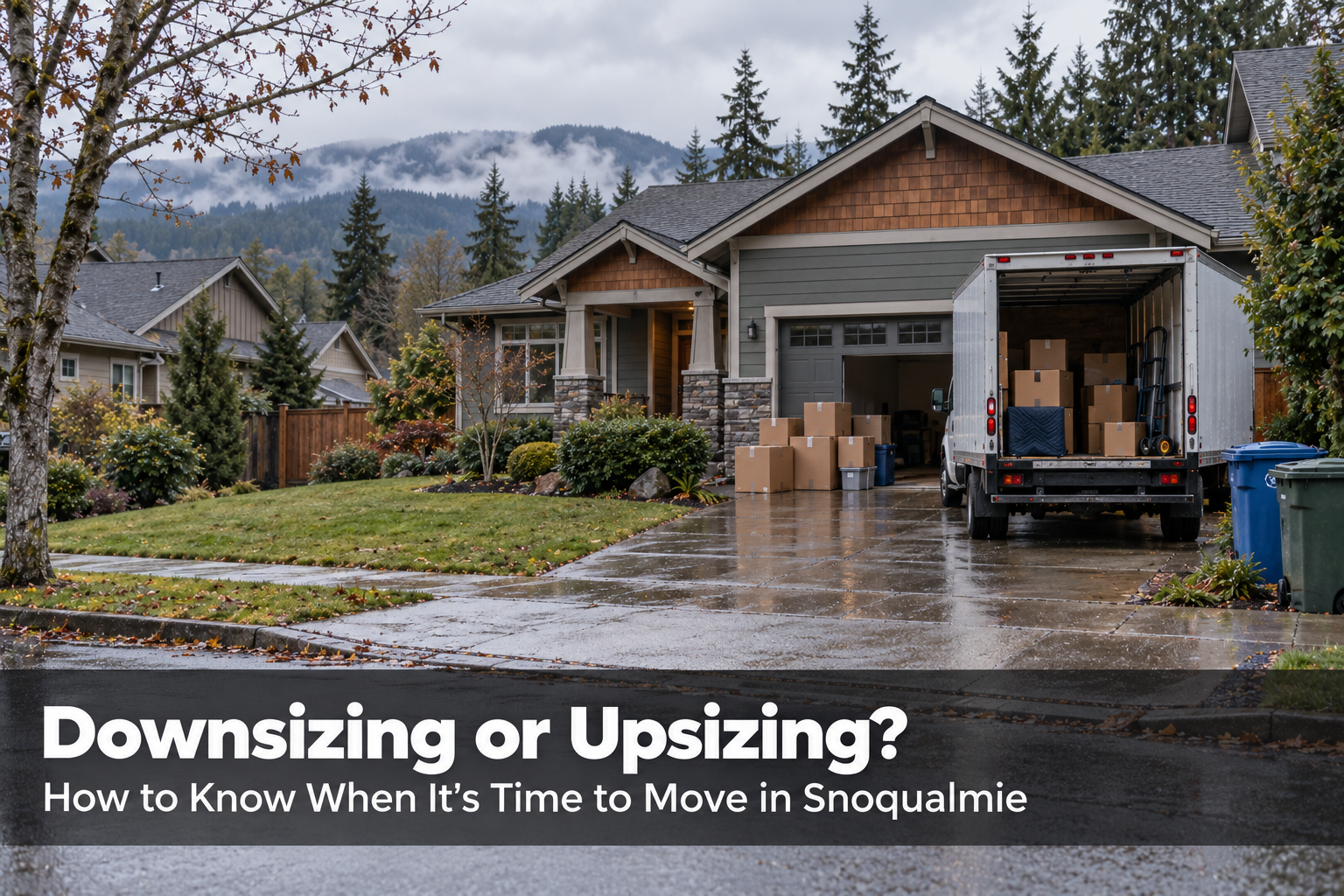
Snoqualmie · Community Photo
The Snoqualmie Valley's low transaction volume and the specific lifestyle character that draws buyers to the valley create a downsizing and upsizing dynamic that is genuinely different from the closer-in Eastside. For valley homeowners, the decision about which direction to move involves not just the financial calculation but the question of whether the valley lifestyle itself remains the right fit.
Signs It's Time to Downsize in Snoqualmie
Valley homeowners who have raised families in larger Snoqualmie Ridge or North Bend properties and are now at the empty nest phase face a specific version of the maintenance question — large homes with significant lot maintenance in a rural-adjacent setting that may feel isolating for empty nesters who want more access to urban amenities and community infrastructure. The valley's commute distance from Eastside employment also weighs differently once children are gone and the school attendance zone that justified the location is no longer relevant.
Downsizing for valley homeowners often means a move to the closer-in Eastside — Kirkland, Redmond, or Bellevue — where smaller, lower-maintenance housing with urban walkability is available. The valley's equity accumulation over the past decade makes that transition financially sound.
Signs It's Time to Upsize in Snoqualmie
Valley buyers who entered through a smaller North Bend or older Snoqualmie home and need more space — additional bedrooms, a dedicated home office, a larger lot for outdoor activities — find that the valley's relative affordability compared to the closer-in Eastside makes the move-up math genuinely accessible within the same market. A move from an $800,000 valley entry to a $1.1 million Snoqualmie Ridge property involves a smaller equity bridge than the equivalent move in Kirkland or Sammamish.
Financial Considerations
Valley homeowners who purchased before 2020 are holding meaningful equity at current median listing prices around $1.13 million. Oregon's Measure 50 — not applicable here — but Washington's lack of a state income tax and the valley's property tax rates relative to closer-in King County are specific financial considerations worth reviewing when comparing a downsize destination within the valley versus a move to the closer-in Eastside.
Making the Transition Smooth
The valley's thin comparable sales pool means that pricing a home for sale — and evaluating a target purchase — requires the most current available data, ideally from the past 30 to 45 days. An agent who regularly closes valley transactions, rather than one who primarily works the closer-in Eastside, understands the specific data limitations and pricing nuances of the valley market.
FAQ: Downsizing and Upsizing in Snoqualmie
What are the benefits of downsizing in Snoqualmie? Capturing valley equity and transitioning to a lower-maintenance, more urban-accessible property — whether within the valley or on the closer-in Eastside — are the primary benefits for valley empty nesters.
When should I upsize in Snoqualmie? The valley's relative affordability compared to the closer-in Eastside makes move-up math genuinely accessible for families who want more space without leaving the valley lifestyle.
Explore more homeowner guides on Explore Snoqualmie. Weighing a move up or down in size? Talk it through with Ed Laine.
Sources: explore-snoqualmie.org, ci.snoqualmie.wa.us, svsd410.org
Every Thursday — local news, events, deals, and new listings. Free forever.